
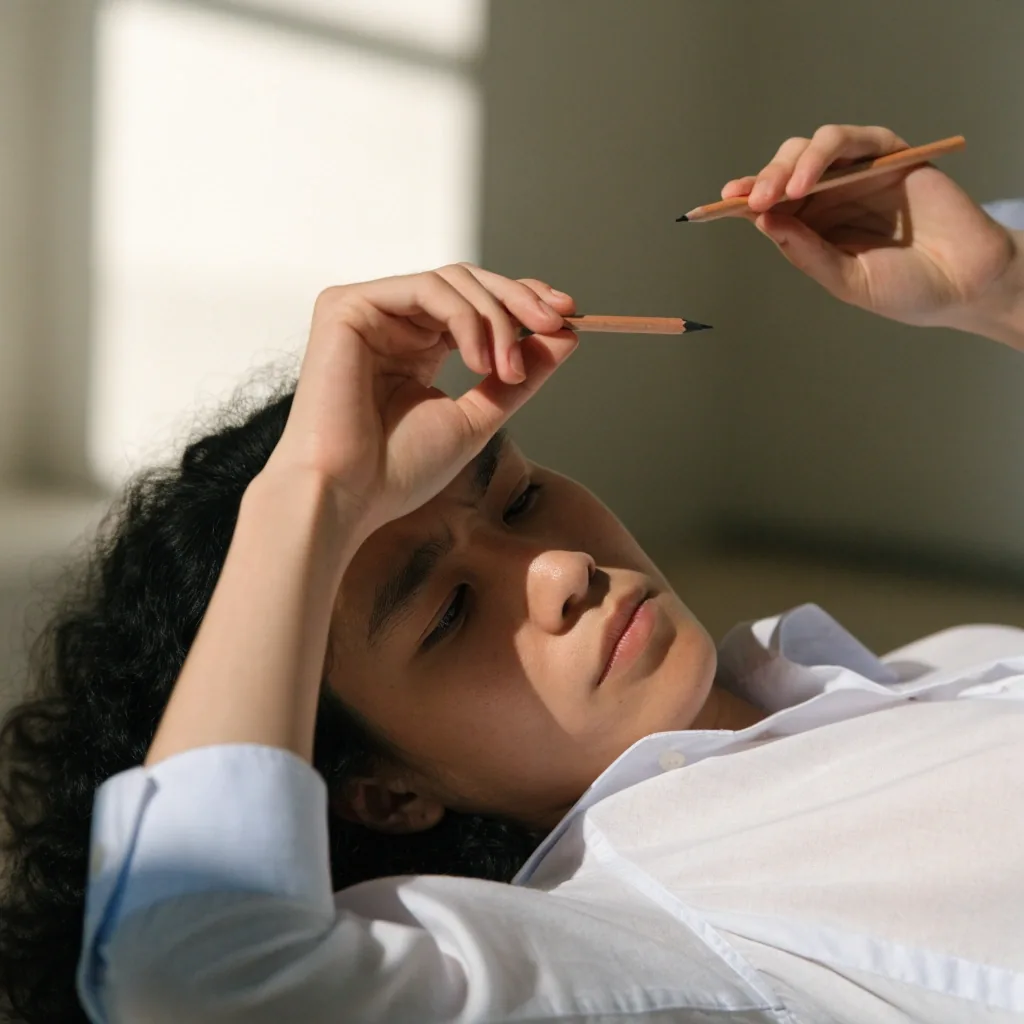
Vision focus methods, explained plainly
Build visual focus habits that fit your screen day
Most people arrive here with the same complaint: their eyes feel tired by mid-afternoon and attention slips during close-up work. We sort through the noise around eye exercises and explain routines you can actually repeat at a desk, in a dorm room, or on a phone between classes.
Start with what your day actually asks of your eyes
If you spend six or eight hours moving between a laptop, a phone, and a second monitor, the strain you feel is usually a near-task problem. Your eyes hold a close focus for long stretches, your blink rate drops, and the muscles that turn your eyes inward for convergence stay engaged. That combination is what the 20-20-20 rule was built around: every twenty minutes, look at something twenty feet away for about twenty seconds.
It is a break habit, not a workout. It costs nothing and takes almost no time, which is why we suggest it as the baseline everyone starts from before adding anything else. People often expect a drill to do what a break already does. Read the screen fatigue page first if your main symptom is burning, dryness, or a heavy feeling behind the eyes. Read the methods library first if your frustration is that you cannot switch focus quickly between a document and a whiteboard.
The baseline habit
Where eye exercises help and where they do not
Vision exercises get oversold. Search the topic and you will find claims that a few drills sharpen eyesight permanently. The more careful position, echoed in eye-care writing, is narrower: exercises can support how the eyes work together, how they track, and how comfortable close work feels. Pencil pushups, for instance, are a near-far drill used when the eyes struggle to converge on close objects. AARP has covered pencil-pushup style exercises as something that may help when the eyes do not work together well for near tasks. That is a functional binocular issue, not a general vision problem, and it is worth naming the difference plainly.
A reasonable expectation
You may notice your eyes recover faster after long reading. You may find it easier to hold a target in focus while switching distances. You will probably not change the prescription on your glasses through drilling.
If you have persistent double vision, headaches after short reading sessions, or one eye that drifts, that is a signal to see an eye-care professional rather than push through another week of home practice.
Four method families, four different jobs
The methods we write about are not interchangeable, and treating them as one blob is why people give up. Group them by what they train.
Convergence drills
Pencil pushups and similar near-far work train the inward turning of the eyes for close tasks.
Read the convergence guideTracking skills
Smooth pursuit and saccades train how your eyes follow a moving target or jump between fixed points.
Restoration habits
Distance gazing and blink breaks reduce accumulated strain rather than build a new skill.
Attention practice
Fixation work, mindfulness, and distraction suppression train sustained attention when the environment is noisy.
Explore attention drillsA student writing essays may only need the third group. A badminton player or a competitive gamer is more likely to want the second and fourth. Someone whose eyes do not converge comfortably on a book belongs in the first, ideally with a professional checking progress.
How much is too much
Daily practice for these routines is usually short, measured in a few minutes per session rather than a full training block. That is not laziness. The tissue involved is small and gets tired quickly, and a drill done while your eyes are already strained teaches you nothing except how to ignore discomfort.
Our general approach: one or two minutes per exercise, once or twice a day, stopped before your eyes feel heavy. If a drill leaves you with a headache, a dull ache around the eyes, or blur that lingers, you have done too much or picked the wrong exercise. Stop, rest, and try a shorter version the next day.
Three or four days a week is a reasonable start, then judge by how the following morning feels.
Adding drills on top of unbroken close work stacks load on a system that is already tired.
Rest, then try a shorter session the next day instead of pushing through a longer one.
Choosing your first routine without guessing
We built this site for people who want a starting point rather than a menu of thirty exercises. Pick by symptom, or pick by the time of day you can actually protect.
Eyes ache and feel dry by evening
Blink breaks and distance gazing
This is a strain problem before it is a skill problem. Complete blinks during close work and real distance through a window or down a hallway give the most back for the least effort.
You lose your place, words seem to swim
Convergence basics
Near-far switching is the better entry point when both eyes do not hold a close target together. Keep sessions short and let a professional check progress if nothing shifts.
You can see fine but zone out
Fixation and timed intervals
Repetitive tasks are an attention problem, not a clarity problem. Short fixation intervals teach more here than any eye drill would.
By time of day
- Between meetings two-minute distance break
- Inside a study block timed fixation interval
- First thing in the morning near-far drill on fresh eyes

A near-far drill at arm's length. Two minutes is a full session.
Which routines are safe to try on your own
Most of what we describe is low-risk when done in short sessions: distance gazing, blink breaks, smooth-pursuit tracking with a moving finger or pen, and simple near-far switching. These are things people do naturally and can repeat without supervision.
Supervised training
Occupational therapy vision drills and convergence insufficiency therapy usually involve an assessment first, then a plan adjusted to what the assessment found. That individualization is the point, and it is why we do not publish a single correct protocol and call it universal.
Low risk on your own
Distance gazing, blink breaks, smooth pursuit with a finger or pen, and simple near-far switching. Short sessions, no equipment, easy to stop.
Middle zone
Pencil pushups sit here. Many home guides describe them and the movement is simple, but the whole point is noticing when the eyes are not converging well. Without that feedback you can practice a compensating habit for months and wonder why nothing changes.
If your symptoms persist past a few weeks of careful home practice, the useful next step is an eye exam, not a longer drill.
What beginners usually get wrong
Three mistakes show up again and again. The first is treating exercises as a substitute for breaks. A two-minute near-far drill does not undo four hours of unbroken close work.
The second is chasing intensity: people assume that if one minute helps, five must help more. With small eye muscles, more usually just means fatigue and a headache. The third is expecting a timeline. Convergence and tracking are physical skills, and skills take weeks of short, consistent practice, not a single heroic weekend session.
Comfort matters in how you practice, not just how long. Distance gazing works better through an actual window or down a hallway than at a wall two feet away; your eyes need real distance to release the close focus. A blink break works better if you let the blink land fully rather than half-closing while you keep reading. These details sound minor and are not.
Why we keep the claims modest
This is an educational site, and educational sites live or die by whether their advice holds up after you try it. We would rather tell you that sleep, screen position, and regular breaks do most of the work than sell you a miracle drill. That is also why you will not find before-and-after galleries or dramatic testimonials here; we have no verified records of that kind, and inventing them would be exactly the thing this site exists to avoid.
What we do offer is a structured comparison of methods, honest limits on each, and plain explanations of the terms you will meet in eye-care writing: accommodation, convergence, fixation, saccades. If you understand those words, you can read any exercise guide and judge it yourself.
Most days, breaks and screen position do more than any single drill.
Questions we get before people start
Do eye exercises actually improve eyesight, or just relieve fatigue?
For most people, the honest answer is relief and function, not a change in eyesight. Exercises used for convergence and tracking can help the eyes work together more comfortably on near tasks. They do not replace glasses or correct a refractive error.
How often should I take visual breaks during laptop or phone work?
The 20-20-20 rule is a reasonable default: about every twenty minutes, look at something far away for around twenty seconds. During heavy reading or gaming, blink breaks every few minutes help as well.
Can blinking more really reduce dry eyes from screens?
Blinking spreads your tear film, and screen work tends to reduce how often and how fully you blink. Deliberate, complete blinks during close work are a simple habit that many people find makes a difference in comfort.
What is the difference between visual focus and eye movement training?
Focus work is about holding or switching clarity between near and far. Eye movement training is about how the eyes travel, following a moving target (smooth pursuit) or jumping between fixed points (saccades). Different skills, different drills.
Pick one routine and give it a week
Start with the routine that matches your symptom, keep sessions short, and judge by how your eyes feel the following morning. If you would rather have help choosing, write to us and describe your screen day.
Jl. Cikini Raya No. 58, Menteng, Jakarta Pusat · Monday to Friday, 9:00 AM – 6:00 PM